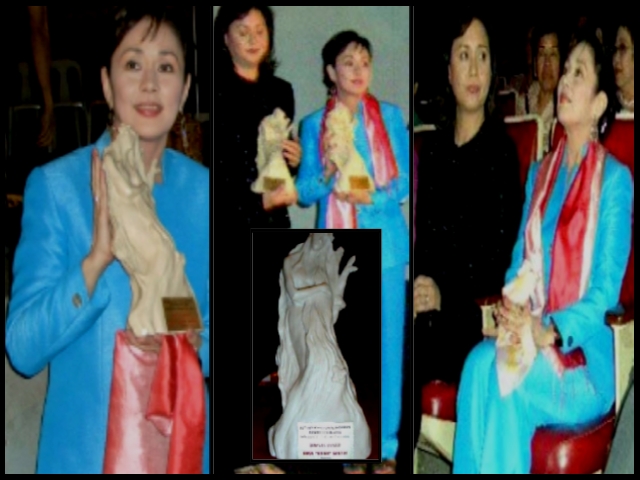
The Milestone Move - No longer a sweet teenager, Vilma's milestone, career move was through Burlesk Queen. By 1977, Vilma's transformation began with her feminist look at her personal life. She no longer care about the gossips/bad publicity created with past relationships concentrating instead with serious projects. Vilma accepted daring roles like "Dalawang Pugad, Isang Ibon," "Nag-aapoy Na Damdamin," "Tagulan sa Tag-araw." And also, as producer, she created some of the best films of that decade, like "Mga Rosas Sa Putikan," "Halik sa Paa, Halik sa Kamay," and the ultimate, "Pagputi Ng Uwak, PagItim ng Tagak" (an almost grand slam winner for best picture). She is one of the very first independent producer in the country. But the most daring of them all was Burlesk Queen. Ian films bet all of its money to this project and it paid off because not only it is the top grosser of the film festival it also reaped almost all of the festival's awards! Sourgraping, the Nora Aunor camp complained but to no avail, all awards were never returned as what the news said few days after it was given. Burlesk Queen established Vilma Santos name as the number one actress in the Philippines. She was featured in Times Magazine in its coverage of the news around the globe.
The hurtful Lost - Ironically, the following year Ian films went to the other camp and produced one of the most stereotypical film of all times, "Atsay." Directed by Eddie Garcia, Nora Aunor gave her most over rated performance of all time. Avoiding the scandal of the previous years and aim at vindicating Nora Aunor, the local festival judges gave her the best performer award over Vilma Santos' impressive performance in "Rubia Servios." Isagani Cruz, a well respected critics during that time emphasized that Rubia was far more superior than Atsay. Cruz even pointed out that although "Nora and Vilma both gave splendid performances, Vilma's role was far more demanding and difficult." And so, as history will tell, it was the "sweetest" victory of Nora Aunor and Noranians over us (the Vilmanians). It was also hurtful because as the victory spread around the archipelago, the news about Ate Vi committing suicide came out. True it was a big disappointment and Marichu Vera Perez attested, she and Vilma cried all night after the awards night but the suicide rumor was just a myth. Vilma will learned from this lost and as we all remember, "lesson learned," she will never expect to win. She'll do her job and let them (or fate) decide if she is deserving of their accolades. The 80's will proves to be more fruitful and kind. Her film efforts gave her fans and movie aficionados every cent of the movie tickets they buy.
From fantasy to reality - As the 70's Box Office Queen, Vilma reinvented herself so many times. She was the disco queen (Rock Baby Rock, Good Morning Sunshine, Disco Fever), the action hero (Darna, Vivian Volta, Wonder Vi), a hunch back bell ringer (Kampanerang Kuba), and a mermaid (Dyesebel) to name a few. But her most significant career changes was her decision to accept mature roles. Roles that gave her gave her so many acting awards (almost 70 to this date!). Speaking of these roles, theres an intrinsic value, most can be viewed as feminism. Roles that gave way for activism and advocacy to further the cause of women, particularly Filipino women. From the ill fated dancer, Chato in "Burlesk Queen," to the liberal-minded, suicidal designer, Sandra in "Ikaw Ay Akin" to rebellious-wife, Ellen in "Broken Marriage," Vilma gave us a true-to-life depictions of what are the most common sufferings of Filipino women. She also educated us with societal social afflictions with her tour de force portrayals of a modern mistress in "Relasyon," an activist nun in "Sister Stella L," a cancer-stricken-career woman in "Pahiram ng Isang Umaga," a mother of autistic child in "Ipagpatawad Mo," an AIDS patient in "Dahil Mahal Kita: The Dolzura Cortez Story," and an awakened mother in "Dekada 70." From fantasy to reality, her body of works deserves the most important award, the National Artist honor.
 The Future - As we all know Vilma has surpassed all of her contemporaries, including Nora Aunor. The future for our idol has become more exciting than ever. Vilma admittedly said that she wanted to stay in show business for as long as she still enjoys it, just like her idol, Gloria Romero, playing grandmother roles. But that’s not gonna happen right now, Vilma still commands the leading roles. She can still carry a film and projects are still pouring-in. And again, unlike her contemporaries, she remained choosy and committed to do "never been done" projects, a well-known secret of her longevity. Indeed, her future remained bright and truly exciting! - RV (READ MORE)
- Official Web-site: MPP
- Official Web-site: FAMAS
- Official Web-site: FAP Luna
- Official Web-site: PMPC STAR
- Official Web-site: UP Gawad Plaridel
- Official Web-site: EnPress (Golden Screen)
- Official Web-site: CMIFF
- Official Web-site: BIFF
- Young Critics Circle Film Desk
- Metro Manila Film Festival
- Artista ng Dekada
- Vilma Santos to be honored at 7th Golden Screen Awards